How to Optimize Content for Google AI Overviews
If you're trying to optimize content for Google AI Overviews, you've probably noticed something shifting in search.
Traditional rankings are still important, but they are no longer the only way websites earn visibility. More and more users are seeing AI-generated summaries appear above organic listings. Instead of clicking through multiple pages, the search engine synthesizes information from several websites and presents a summarized answer.
That shift has sparked conversations around Generative AI SEO, how to rank in AI Overviews, and how to appear in AI search results.
Here’s the reality based on my experience working in SEO.
AI SEO isn’t a brand new discipline. It’s structured clarity plus authority.
I’ll be real, I didn’t originally set out to optimize for AI search. My clients started appearing in Google AI Overviews before I was intentionally trying to make that happen. Once I noticed the pattern, I analyzed why certain pieces of content were appearing as cited sources in AI summaries and made those strategies repeatable.
Today, improving AI visibility has become an intentional part of how I approach search engine optimization.
What Google AI Overviews Actually Do
Before discussing strategy, it helps to understand what AI Overviews are.
Google introduced AI Overviews to help the search engine synthesize information from multiple trusted sources and present users with summarized answers directly in the search results.
These summaries typically include links to the websites used to generate the response, which means those sites become cited sources inside the AI summary.
Industry research shows that AI Overviews are appearing more frequently across search results, with one analysis reporting a significant increase in AI-generated summaries across multiple industries. This highlights how quickly the feature is expanding.
This shift changes how visibility works.
Instead of competing only for rankings, websites now compete to become sources that AI systems cite when generating answers.
That means SEO strategy must consider both traditional rankings and AI visibility.
Here is an example showing a client article appearing as a cited source inside Google’s AI generated search results.
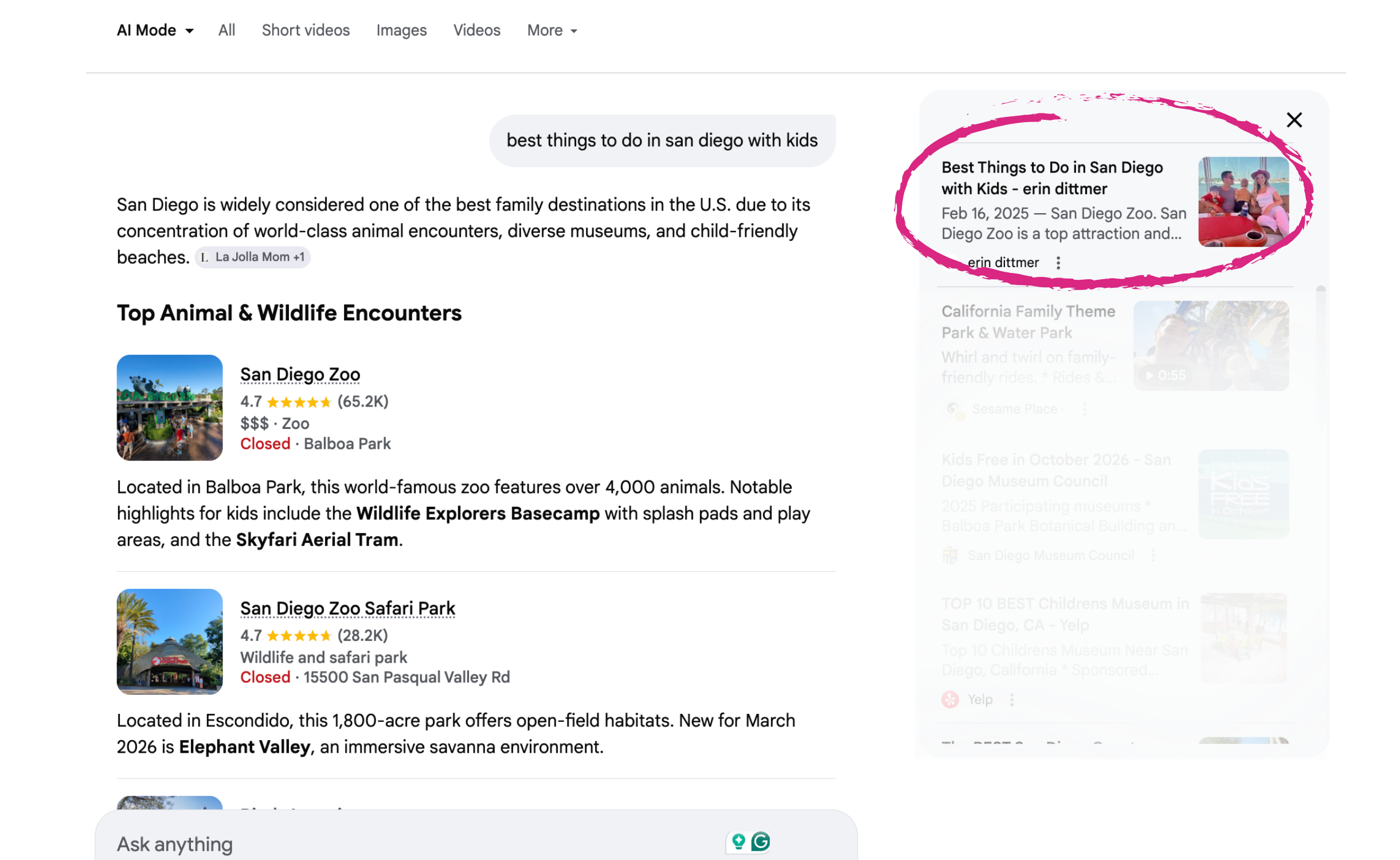
This type of visibility demonstrates how search engines now surface trusted sources directly inside AI-generated summaries, increasing the importance of creating content that is structured, authoritative, and easy for the search engine to interpret.
That means SEO strategy must consider both traditional rankings and AI visibility.
The Four Pillars to Optimize Content for Google AI Overviews
1. Maintain the Technical Health of Your Website
Technical SEO remains foundational for both traditional search rankings and AI-driven search results.
If your website has weak architecture, slow loading pages, or poor internal linking, it becomes harder for search engines to understand and evaluate your content.
Important technical elements include:
Clean URL structures
Logical site architecture
Clear H1 and H2 hierarchy
Strong internal linking
Fast page load speeds
Proper indexing and crawlability
AI systems do not evaluate pages in isolation. They interpret content within the context of an entire domain.
A technically sound website signals trust and authority to the search engine.
2. Build Topical Authority Across Your Site
Appearing in AI summaries rarely happens because of a single article. It occurs when a website demonstrates authority across a topic.
For example, one of my clients in the Caribbean cuisine space recently appeared as a cited source in a Google AI Overview for a query related to curry goat.
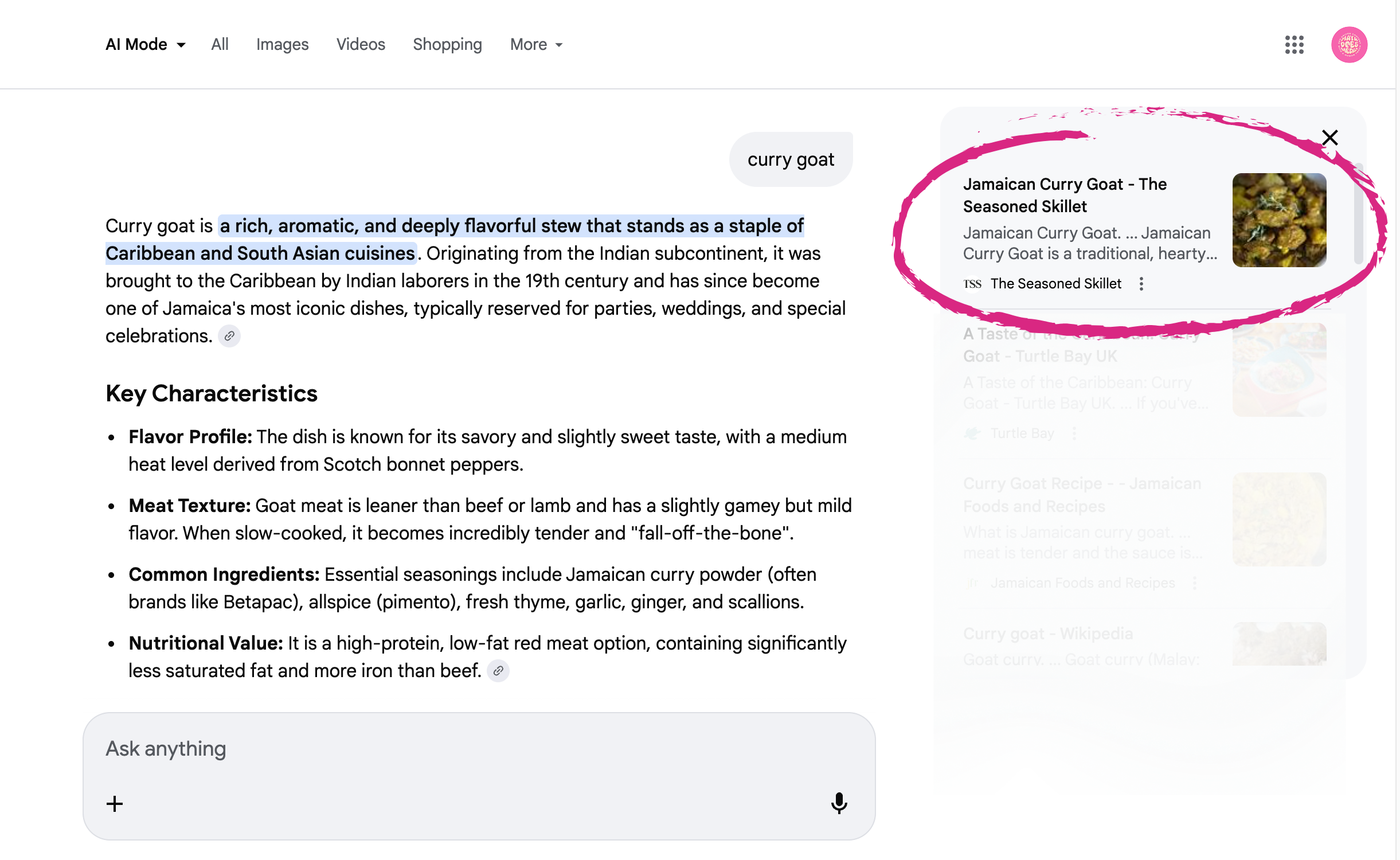
Example of a blog post being cited inside Google’s AI-generated search results, demonstrating how well-structured content can improve AI visibility.
That visibility was not created by one definition paragraph alone. It happened because the website had extensive topical coverage including:
• Traditional Jamaican recipes
• Ingredient breakdowns
• Cultural context
• Related cooking techniques
Internal linking reinforced relationships between these topics, which helped the search engine understand the site as a reliable source within that niche.
When optimizing your website for AI search, it is helpful to think in terms of content ecosystems rather than individual posts.
Topical authority increases the likelihood that your content becomes a cited source when AI systems generate summaries.
3. Structure Content So It Is Easy for Search Engines to Extract
One of the biggest misconceptions about optimizing for AI search results is that you need to write specifically for large language models. You don’t need to write for LLMs but you do need to write clearly.
Content that appears in AI summaries often shares structural characteristics such as:
Clear definitions near the top of the article
Direct answers to common questions
Scannable headers
Concise explanations
Minimal fluff before the main answer
Research analyzing how pages rank in relation to People Also Ask (PAA) questions supports this approach. One study found that pages ranking in the top results often answer a larger number of related PAA questions, making the content semantically richer and easier for search engines to interpret.
However, the research also found that answering questions alone is not enough to rank well. Technical quality, authority signals, and user experience still matter.
This aligns closely with how AI Overviews work. AI systems extract blocks of information that clearly answer user questions. When your content provides structured answers, it becomes easier for the search engine to include it in AI summaries.
4. Update Content to Stay Competitive
SEO is no longer static.
If you want to improve your chances of appearing in AI Overviews, your content cannot remain unchanged for years.
Updating content helps you:
Improve clarity and formatting
Strengthen definitions
Add new FAQs based on evolving search intent
Expand topical coverage
Improve internal linking
Align with new search behavior
AI-generated summaries rely on current, relevant information. Sites that continually refine their content remain more competitive.
Why Traditional SEO Still Matters
There is a growing narrative that traditional SEO is no longer enough and there is some truth to that.
Ranking alone does not guarantee visibility anymore. However, abandoning SEO fundamentals is not the answer.
Instead, the goal is to create content that is strong enough to serve both traditional search rankings and AI-generated summaries.
That means combining:
technical site health
topical authority
structured answers
clear search intent alignment
These are the same fundamentals I talk about in my guide on How to Boost SEO, and they remain the foundation for both traditional search performance and AI visibility.
When these elements are in place, improving AI visibility becomes a natural extension of good SEO practices.
Frequently Asked Questions About AI Overviews
How do you appear in Google AI Overviews?
Websites that appear in AI Overviews typically demonstrate strong topical authority, clear information structure, and technically sound SEO foundations. AI systems prioritize sources that clearly answer user questions.
How do you optimize your website for AI search?
Optimizing for AI search involves improving site architecture, strengthening internal linking, and structuring content so that answers are easy for a search engine to interpret and extract.
How do you become a cited source in AI summaries?
Content becomes a cited source when it provides clear, authoritative answers within a well-structured and trusted website.
What is Generative AI SEO?
Generative AI SEO refers to optimizing content for environments where search engines synthesize information into summaries rather than simply ranking links.
Are AI Overviews replacing traditional search?
AI Overviews are changing how users interact with search results, but traditional rankings remain important. The most effective strategy focuses on optimizing for both.